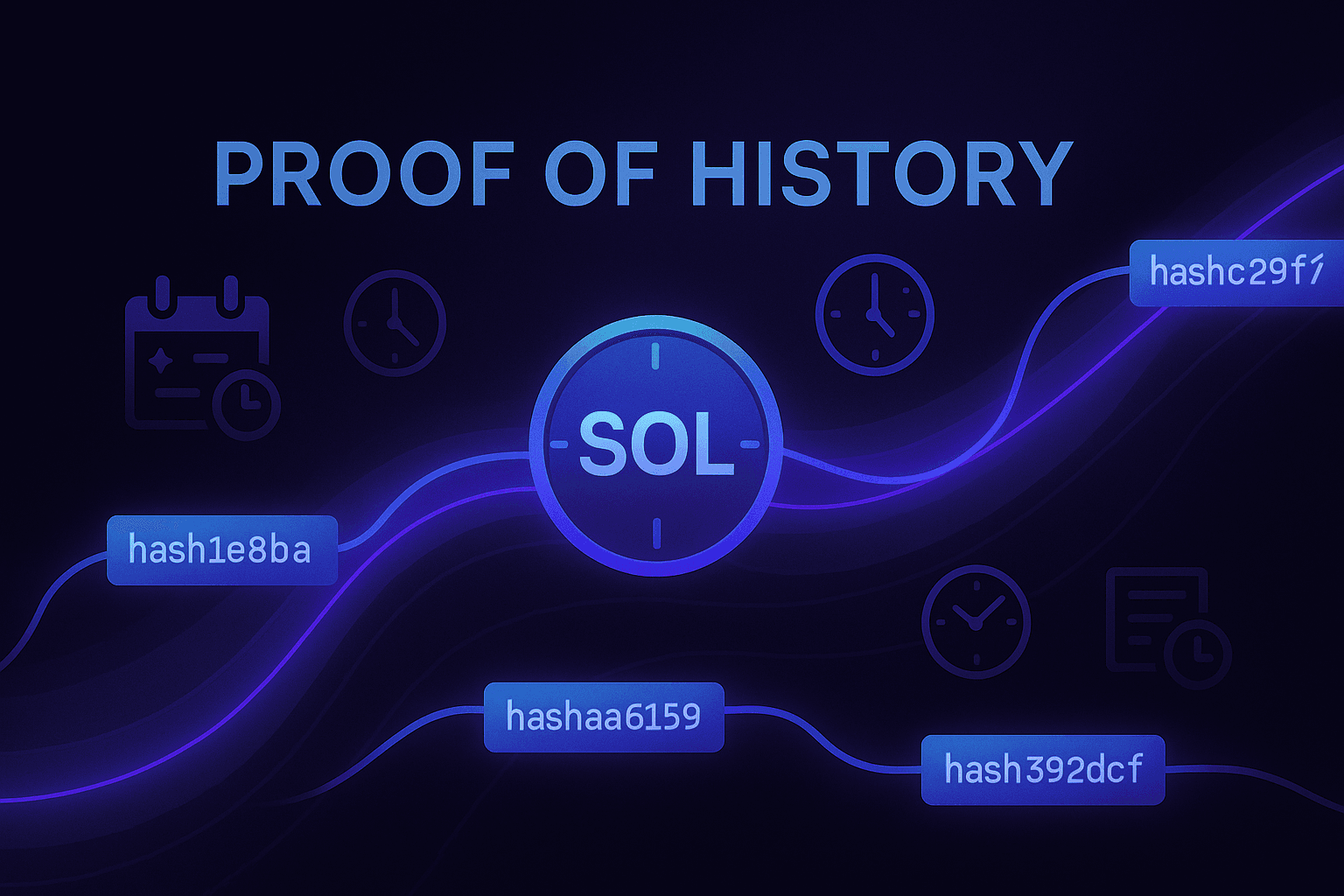
Explaining Proof of History Like You're 5 Years Old
#The Big Problem: What Slows Other Blockchains Down?
#Imagine you're in a classroom where students must turn in their homework.
- Every student hands in their paper at the same time
- The teacher (Ethereum) has to figure out who turned it in first by asking each student
- This takes forever!
This is what happens in most blockchains—they waste time trying to agree on the order of transactions.
The Magic Solution: Proof of History (PoH)
#Now, imagine the teacher gives each student a special digital clock.
- When a student finishes their homework, the clock records the exact time
- The teacher doesn't need to ask who was first—she just looks at the clocks!
Now, everything is automatic, fast, and organized!
This is exactly how Proof of History (PoH) works!
- It automatically timestamps transactions, so the network doesn't have to argue about the order
- No waiting, no delays!
How Proof of History Keeps Solana Fast
#In Bitcoin and Ethereum, transactions are like students shouting all at once:
- "I paid first!"
- "No, I did!"
- "Let's vote on it!"
Everyone argues before the transactions are confirmed.
In Solana, transactions are like students with digital clocks:
- "Here's my exact time!"
- "Confirmed instantly!"
No arguing. No delays. Everything runs smoothly.
Why Proof of History is So Powerful
#- Solana doesn't need to wait for all validators to agree—transactions are already ordered
- Validators just check if the timestamps match instead of redoing the work
- This saves time, making Solana one of the fastest blockchains ever
Summary: Proof of History in Simple Terms
#- Other blockchains argue about transaction order (slow)
- Solana records the order instantly using PoH (fast)
- PoH is like a magic stopwatch that keeps track of everything
- This makes Solana one of the fastest blockchains in the world!
Context & Problem Statement (Technical Deep Dive)
#(Reference: Solana Whitepaper, Section 4, Pages 3-7)
This is the most important part of Solana's design because Proof of History (PoH) is what sets it apart from traditional blockchains. We will break it down carefully, ensuring that every detail is covered.
Traditional blockchain architectures face a fundamental challenge: how do you prove that a transaction happened at a specific time without trusting a central authority? This seemingly simple question has plagued distributed systems for decades.
Bitcoin and Ethereum solve this problem through expensive consensus mechanisms that require all nodes to communicate and agree on transaction ordering. This creates inherent bottlenecks that limit throughput and increase latency. The core issue isn't computational power—it's the need for synchronous agreement on time.
Solana's whitepaper presents a revolutionary solution: what if we could create a cryptographically verifiable clock that all nodes could trust without communication? What if we could eliminate the need for consensus on time entirely?
Why Was Proof of History (PoH) Created?
#Blockchains need to agree on the order of transactions before confirming them.
The Problem with Existing Blockchains
#Bitcoin and Ethereum do not have a built-in clock. Instead, they rely on validators (miners or stakers) to manually agree on the order of transactions, which causes delays:
- Bitcoin: Transactions are bundled into blocks every 10 minutes and verified through Proof of Work
- Ethereum: Uses a slightly faster system with Proof of Stake but still needs validators to reach a consensus
Both systems have a problem:
How do you prove that a transaction happened at a specific time without trusting a central authority?
Why is it so difficult for Bitcoin and Ethereum to build this clock?
The challenge isn't technical—it's architectural and philosophical:
- Decentralization Requirements: Any clock must be trustless and not rely on external time sources
- Consensus Complexity: Adding time consensus would require additional communication overhead
- Security Trade-offs: A centralized clock creates a single point of failure
- Backward Compatibility: Existing networks can't easily add fundamental changes without hard forks
Solana solves this by introducing a cryptographic timestamping system called Proof of History (PoH).
"Proof of History is a sequence of computation that can provide a way to cryptographically verify passage of time between two events."
– (Solana Whitepaper, Page 3)
What is Proof of History?
#PoH is like a trustless, verifiable clock for the blockchain. It allows nodes to agree on the order of events without having to communicate with each other first.
How It Works (Step-by-Step Explanation)
#- Solana uses a cryptographic function that continuously runs in a sequence
- Each new output depends on the previous output, creating a verifiable chain of timestamps
- Anyone can recompute this sequence to confirm that time has passed without needing to trust a third party
Practical Example: Imagine you're tracking a marathon runner. Instead of asking each checkpoint "what time did the runner pass?", you give each checkpoint a stopwatch that records the exact time automatically. Now, you can verify the runner's progress by checking the stopwatch times without trusting the checkpoint operators.
5-Year-Old Analogy: Think of PoH like a magic stopwatch that never stops ticking. Every time something important happens (like a transaction), the stopwatch records the exact time. Later, when you want to know what happened first, you just look at the stopwatch times—no need to ask anyone!
"It uses a cryptographically secure function written so that output cannot be predicted from the input, and must be completely executed to generate the output."
– (Solana Whitepaper, Page 3)
This ensures that transactions are time-stamped in an unalterable order.
Proof of History Sequence (Example from the Whitepaper)
#The whitepaper provides an example of how PoH works by chaining hash functions together.
| Index | Operation | Output Hash |
|---|---|---|
| 1 | sha256("random value") | hash1 |
| 2 | sha256(hash1) | hash2 |
| 3 | sha256(hash2) | hash3 |
| 4 | sha256(hash3) | hash4 |
Each new hash depends on the previous one, ensuring that no one can predict future values without running the function step by step.
"There is no way to predict what the hash value at index 300 is going to be without actually running the algorithm from the starting value 300 times."
– (Solana Whitepaper, Page 4)
This means that real-time must have passed between index 1 and index 300, proving the passage of time.
Does it tell the time like "this transaction was passed at 3:25am"?
Not exactly. PoH doesn't provide wall-clock time (like 3:25 AM). Instead, it provides relative ordering—it proves that Transaction A happened before Transaction B, and Transaction B happened before Transaction C. The actual wall-clock time is less important than the cryptographic ordering that enables fast consensus.
Why Does PoH Matter?
#Traditional blockchains waste time making all nodes agree on transaction order before moving forward.
PoH solves this by giving every node a pre-agreed global clock:
- Transactions arrive pre-ordered, removing the need for validators to arrange them
- The network processes transactions continuously, instead of waiting for blocks
- No need for timestamp disputes—everyone can verify the order mathematically
What does "pre-ordered" mean?
"Pre-ordered" means that when transactions arrive at the network, they're automatically assigned a position in the PoH sequence based on when they were received. This eliminates the need for validators to communicate and agree on ordering—the order is already determined by the PoH clock.
This allows Solana to reach sub-second finality, something Bitcoin and Ethereum cannot achieve.
Using PoH to Timestamp Events
#PoH can also embed external data (such as transactions or messages) directly into the sequence.
For example, let's say a user uploads a photograph at index 336:
| Index | Operation | Output Hash |
|---|---|---|
| 1 | sha256("random value") | hash1 |
| 200 | sha256(hash199) | hash200 |
| 300 | sha256(hash299) | hash300 |
| 336 | sha256(append(hash335, photo sha256)) | hash336 |
By including the photo's cryptographic hash, the system proves that this image existed before index 336 was generated.
This is useful for:
- Timestamping files & documents (like digital notary services)
- Tracking financial transactions in real-time
- Proving when an event happened without relying on a central authority
Why don't we hear as much about these particular applications IRL?
These applications exist but are less visible because:
- Infrastructure Complexity: Building on PoH requires specialized knowledge
- Ecosystem Maturity: Solana's ecosystem is still developing compared to Ethereum
- Use Case Discovery: Developers are still exploring PoH's unique capabilities
- Marketing Focus: Most attention goes to DeFi and NFTs rather than timestamping
Real-world examples of PoH applications:
- Arweave: Uses similar timestamping for permanent data storage
- Chronicle Protocol: Oracle network using PoH for price feed timestamps
- Clockwork: Solana program for automated task scheduling
- Metaplex: NFT metadata timestamping for provenance
"The recording of the state, index, and data as it was appended into the sequence provides a timestamp that can guarantee that the data was created sometime before the next hash was generated in the sequence."
– (Solana Whitepaper, Page 5)
How PoH is Verified
#Since PoH is just a sequence of hashes, anyone can verify it quickly.
Parallel Verification Using GPUs
#Instead of verifying the entire sequence on one computer, Solana uses thousands of GPU cores to verify different sections at the same time.
For example:
- Core 1 checks hashes 1-1000
- Core 2 checks hashes 1001-2000
- Core 3 checks hashes 2001-3000
This allows the network to verify transactions in parallel, drastically reducing verification time.
"The sequence can be verified correct by a multicore computer in significantly less time than it took to generate it."
– (Solana Whitepaper, Page 6)
What implications do these have on Solana?
Scalability: More GPUs mean faster verification, enabling higher throughput Cost: GPU requirements create higher hardware costs for validators Centralization Risk: Expensive hardware requirements could limit validator participation
How many GPUs can be used as operations get bigger?
Theoretically unlimited, but practically limited by:
- Economic constraints (GPU costs vs. rewards)
- Network coordination (splitting work efficiently)
- Diminishing returns (communication overhead)
Does that also mean more electricity is being used?
Yes, but with important caveats:
- More efficient than PoW: GPUs are more energy-efficient than ASICs
- Parallel processing: Better utilization than sequential verification
- Economic incentives: Validators optimize for profit, not maximum power consumption
PoH vs. Traditional Blockchain Timing Methods
#| Feature | Bitcoin/Ethereum | Solana (PoH) |
|---|---|---|
| How time is measured | Blocks are mined every 10s-10min | Continuous cryptographic clock |
| Transaction ordering | Nodes manually agree on order | Transactions are auto-ordered |
| Speed | Slow (needs global agreement) | Fast (pre-ordered transactions) |
| Finality | Minutes to hours | Sub-second |
PoH eliminates the waiting time that slows down other blockchains, making Solana one of the fastest networks in the world.
Attacks & Security Considerations
#Reversal Attack
#Since PoH depends on sequential hashing, an attacker cannot compute a reverse sequence to fake the past.
Speed Attack
#An attacker trying to fake history would need a supercomputer faster than the entire Solana network, which is highly impractical.
Does AI have the probability of doing that in the coming years?
While AI advances are significant, this attack would require:
- Computational breakthroughs in cryptographic hash functions
- Massive parallel processing exceeding the entire Solana network
- Economic incentives that make such attacks profitable
The cryptographic security of SHA-256 (used in PoH) is still considered unbreakable by current technology, including AI.
Long-Range Attack
#Even if an attacker gets access to old private keys, they would need to recompute history in real-time, making it nearly impossible to rewrite past transactions.
"A malicious user that gains access to old private keys would have to recreate a historical record that takes as much time as the original one they are trying to forge."
– (Solana Whitepaper, Page 7)
Conclusion & What's Next
#Key Takeaways
#- Proof of History (PoH) is Solana's biggest innovation—it acts as a built-in clock for transaction ordering
- Transactions arrive pre-ordered, allowing for sub-second finality
- Solana achieves massive speed gains by eliminating communication delays found in Bitcoin & Ethereum
- The PoH sequence is secure and tamper-proof, making it resistant to attacks
What's Next
#In the next section, we will explore Solana's Proof of Stake (PoS) Consensus—how validators stake tokens, how elections work, and how Solana keeps the network secure.
The Proof of History mechanism we've explored today provides the cryptographic foundation that enables Solana's unprecedented performance. By eliminating the need for consensus on time, PoH allows Solana to process transactions at a scale and speed that was previously impossible in blockchain systems.
This article is part of the Solana Whitepaper Series. Read Part 1: Introduction & Core Idea | Read Part 2: Network Design | Read Part 4: Proof of Stake Consensus (Coming Soon)