An analysis of payments, data, and the battle for Africa's financial infrastructure
Introduction
#On January 5, 2026, Africa's largest fintech company, Flutterwave, announced it had acquired Mono, Nigeria's leading open banking infrastructure provider, in an all-stock transaction valued between $25 million and $40 million. The official narrative framed this as a strategic move to build interoperable commerce infrastructure across the continent. The press releases spoke of synergies, expanded capabilities, and Africa's next payments chapter.
But beyond the corporate communications lies a more complex and consequential story. One that touches on data governance, ecosystem neutrality, competitive dynamics, and the very architecture of African finance for the next decade.
This acquisition signals that Africa has entered what might be called the financial infrastructure consolidation era. The continent's fintech industry, now over a decade into its modern evolution, is moving from a phase of startup proliferation to one of vertical integration and infrastructure control. The companies that control the rails (payments, identity, data, and connectivity) will shape the economic trajectories of millions.
This article aims to explore the dynamics beneath surface-level reporting: what Flutterwave actually acquired, why it matters strategically, the governance questions the ecosystem must now confront, and what this deal portends for the future of African fintech.
What Flutterwave Actually Bought
#To understand this acquisition's significance, one must first understand what Mono actually is. It is far more than an API company.
Mono has built Africa's most comprehensive open banking infrastructure, enabling businesses to access consented financial data from customers' bank accounts. Since its launch in 2020, Mono claims to have facilitated over 8 million bank account linkages (representing approximately 12% of Nigeria's banked population) and delivered 100 billion financial data points to lending companies.
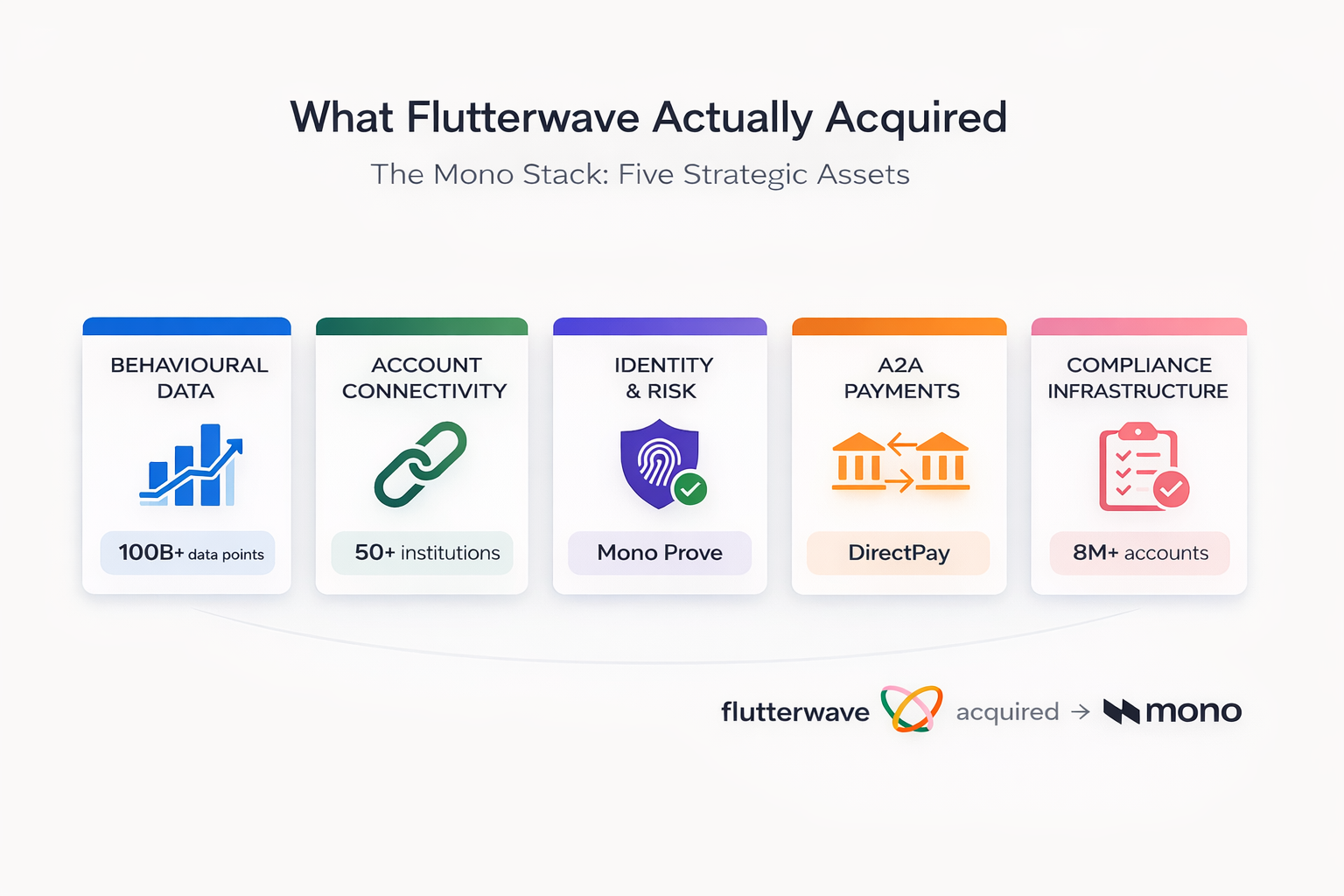
The real assets Flutterwave acquired include:
Behavioural Financial Data: Transaction histories, spending patterns, income verification, and cashflow analysis across millions of Nigerians. This is the fuel for modern credit decisioning.
Account Connectivity: API connections to over 50 financial institutions across Nigeria, Kenya, Ghana, and South Africa, including major banks, fintechs, and telecom operators like MTN.
Identity and Risk Signals: Mono Prove, an AI-powered identity verification product featuring facial recognition, liveness detection, and anti-spoofing measures, plus the infrastructure to verify account ownership, assess creditworthiness, and detect fraud.
Account-to-Account (A2A) Payments: Through Mono DirectPay, businesses can initiate authenticated bank-to-bank payments, bypassing card networks entirely.
Compliance and Underwriting Infrastructure: KYC acceleration, automated bank statement collection, and the analytical tools that make instant loan decisioning possible.
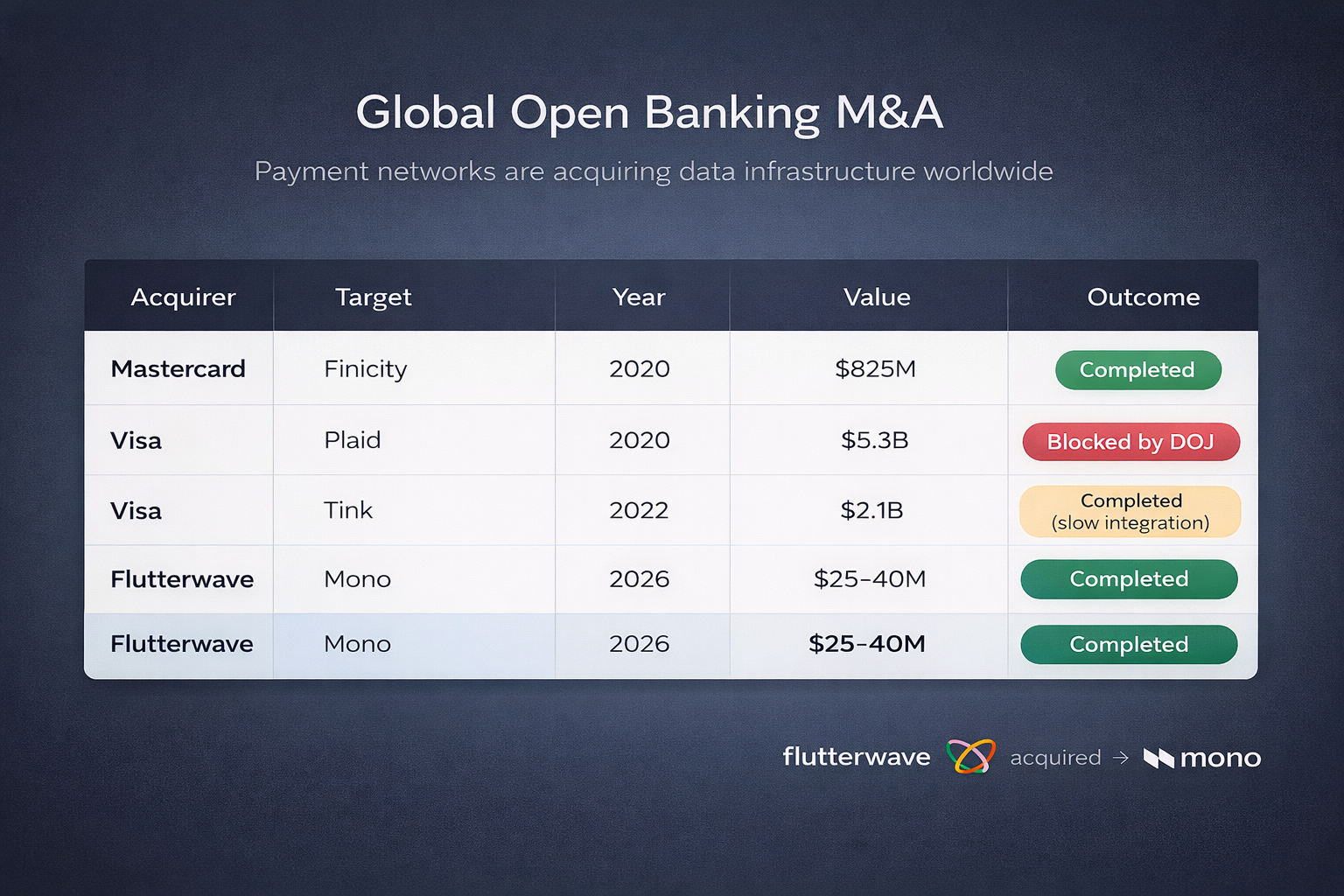
The global parallels are instructive. In 2020, Mastercard acquired Finicity for $825 million to gain similar open banking capabilities in North America. That same year, Visa attempted to acquire Plaid for $5.3 billion. The U.S. Department of Justice blocked that deal on antitrust grounds, arguing Plaid was a nascent competitor that could disrupt Visa's debit monopoly. Visa's European acquisition of Tink has faced similar integration challenges. The pattern is clear: payments giants globally recognize that financial data infrastructure is becoming as valuable as (perhaps more valuable than) payment rails themselves.
Why This Move Is Strategically Huge
#The fundamental economics of payments explain why Flutterwave made this move. Payment processing, particularly at scale, is a low-margin business. Transaction fees face constant downward pressure from competition, regulation, and customer expectations. The margins on moving money from point A to point B continue to compress.
Data, however, operates on different economics. The value of behavioral financial data compounds: the more you have, the more insights you can derive, the better your risk models become, and the more services you can offer. This is the logic that has driven Ant Financial's dominance in China and Nubank's rapid ascent in Latin America.
For Flutterwave specifically, this acquisition represents a strategic pivot from being primarily an app-layer company (facilitating payments for merchants) to becoming an infrastructure company (controlling the underlying rails). This distinction matters enormously. App-layer businesses compete on features and price. Infrastructure businesses create moats and capture more value from every transaction.
The timing is also notable. Flutterwave has long signaled IPO ambitions, and this acquisition strengthens their positioning considerably. A payments company is one thing; a vertically integrated financial infrastructure platform with data capabilities, identity verification, and A2A payments is another entirely. The latter commands higher multiples and tells a more compelling growth story to public market investors.
This deal also strengthens Flutterwave's competitive moat across African markets. With Mono's infrastructure, Flutterwave can now offer faster onboarding, improved verification, reduced fraud, and seamless account-to-account payments within a single stack. These are capabilities competitors will find difficult to replicate without their own data infrastructure acquisitions.
Crash Course: What Open Banking Really Is
#Open banking is one of those terms that gets thrown around frequently but is often poorly understood. At its core, open banking is a framework that allows consumers to share their financial data with third parties through secure APIs, with their explicit consent.
The concept emerged from a simple recognition: banks hold enormous amounts of data about customers (transaction histories, income patterns, spending behaviors) but that data has historically been locked inside bank systems. Open banking unlocks this data, allowing customers to grant access to fintechs, lenders, and other service providers who can then offer more tailored financial products.
In mature markets like the UK (where open banking became regulatory mandate in 2018) and the EU (under PSD2), standardized APIs allow any authorized third party to access bank data with customer consent. In markets like Nigeria, where open banking frameworks are still evolving, companies like Mono have built proprietary API connections to banks, functioning as de facto open banking infrastructure even without formal regulatory standardization.
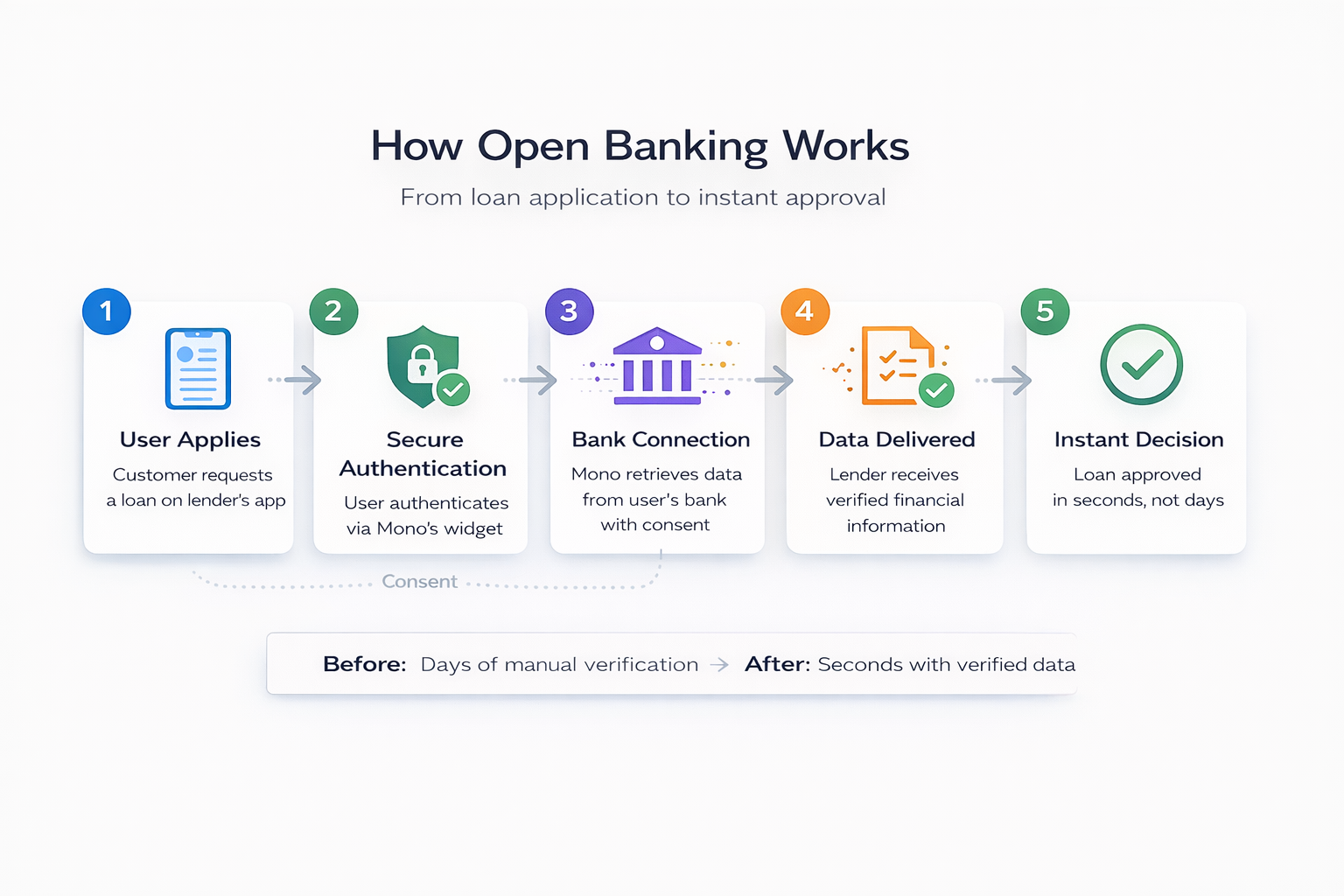
How it works in practice: When you apply for a loan from a digital lender in Nigeria, instead of downloading your bank statements and uploading PDFs, you authenticate through Mono's widget, which securely retrieves your financial data directly from your bank. The lender receives verified, real-time information about your transactions, income, and account balances. This transforms credit decisioning from a manual, days-long process into something that can happen in seconds.
In the African context, where credit bureaus remain underdeveloped and formal financial histories are sparse for much of the population, open banking takes on additional significance. It provides an alternative pathway to creditworthiness assessment. One based on actual financial behavior rather than traditional credit scores that may not exist.
The connection between open banking and account-to-account (A2A) payments is direct. Once you have authenticated access to a customer's bank account for data purposes, the infrastructure to initiate payments from that same account is a natural extension. This is precisely what makes open banking providers like Mono so strategically valuable: they are not just data companies but potential payment rails.
Verified: Who Uses Mono and What That Means
#A. Publicly Confirmed Users
#Carbon: The digital lending company was Mono's first major customer. Carbon's CEO, Chijioke Dozie, discovered Mono through a Medium post announcing the app's launch in 2020 and reached out to founder Abdulhamid Hassan. Hassan was initially skeptical ("I had ₦500,000 in my account. Okra had $1 million. I wasn't going to compete," he recalls), but Dozie insisted. Over a weekend, Hassan's team built an API. Carbon tested it, loved its speed, and urged him to build a company. Carbon's use of Mono has been publicly confirmed in multiple interviews and reports.
Piggyvest: The savings and investment platform has been reported by TechCabal as using Mono's infrastructure for account connectivity and verification.
Mastercard: Mono has a public partnership with Mastercard. In 2022, Mono became the first Nigerian and Open Banking company to join the inaugural Mastercard Open Banking Start Path Program. In 2024, the companies announced a collaboration to introduce account-to-account payments powered by Mastercard Gateway.
B. Mono's Coverage and Customer Base
#According to reporting from TechCrunch and other sources, Mono's customers include Visa-backed Moniepoint and GIC-backed PalmPay. Mono's CEO has stated that nearly all Nigerian digital lenders now rely on Mono's infrastructure. The company has connectivity with major banks (GTBank, Access, UBA, and others), digital banks like Kuda, and fintechs including Paystack.
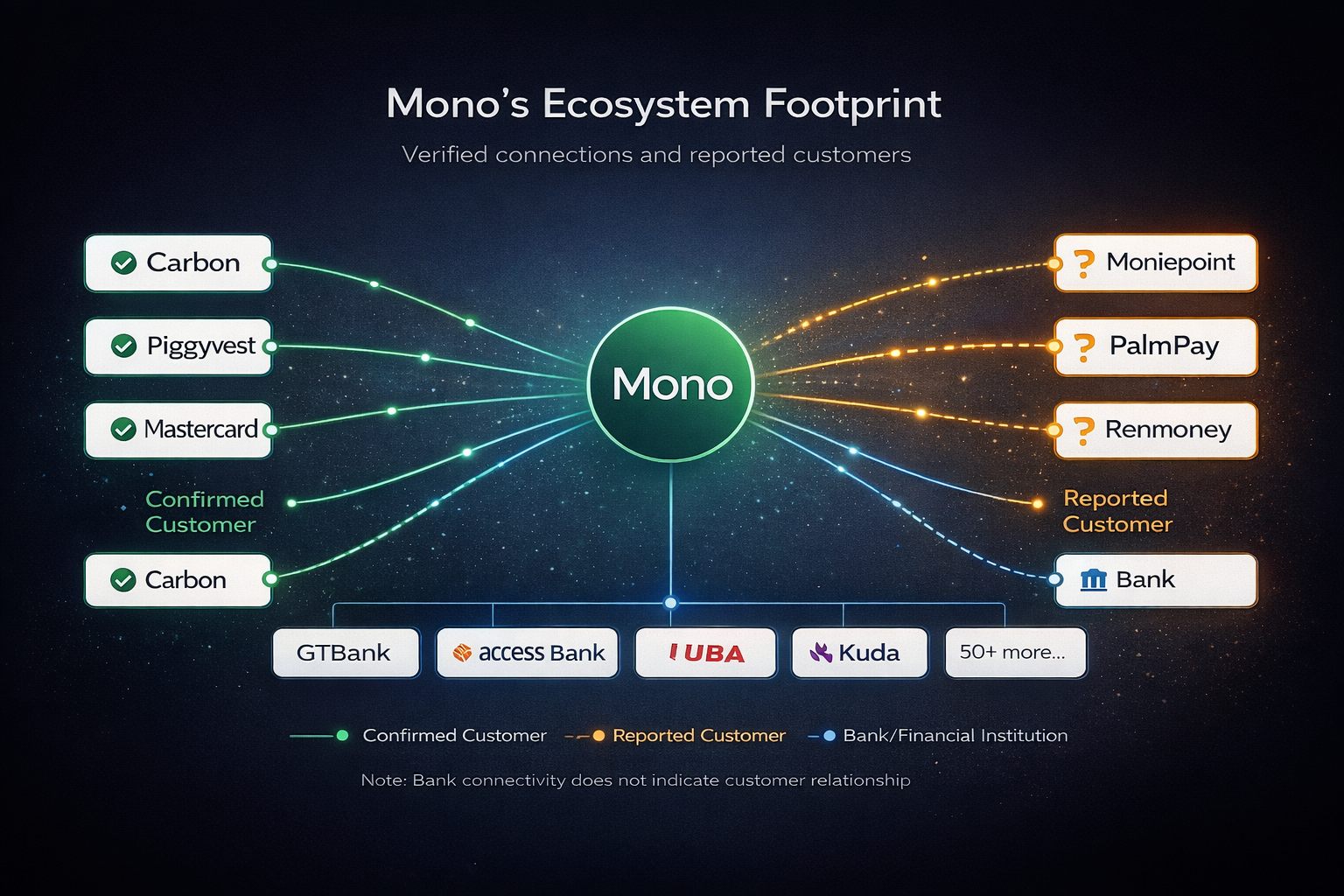
Important clarification: Coverage does not necessarily mean active customer relationship. Mono's connectivity map shows which institutions it can technically access. It does not confirm active commercial relationships with all named institutions.
C. Why This Matters
#Mono's deep ecosystem footprint demonstrates just how foundational open banking infrastructure has become to Nigeria's fintech sector. The company's claim of powering nearly all digital lenders in Nigeria (if accurate) suggests that a significant portion of the country's credit decisions now flow through Mono's rails.
The Untold Story: Neutrality, Governance, and Ecosystem Power
#Here is where the analysis must move beyond the celebratory press releases. Infrastructure businesses derive much of their value from neutrality. From being platforms that serve an entire ecosystem rather than competitors within it.
The U.S. Department of Justice's reasoning in blocking Visa's acquisition of Plaid is instructive here. The DOJ argued that Visa, as a dominant payment network, would have competitive incentives to disadvantage Plaid's other potential uses or partners. Visa's CEO had described the acquisition as "an insurance policy" to neutralize a "threat to our important US debit business." The concern was that combining data infrastructure with payment rails under a single competitive entity could foreclose competition.
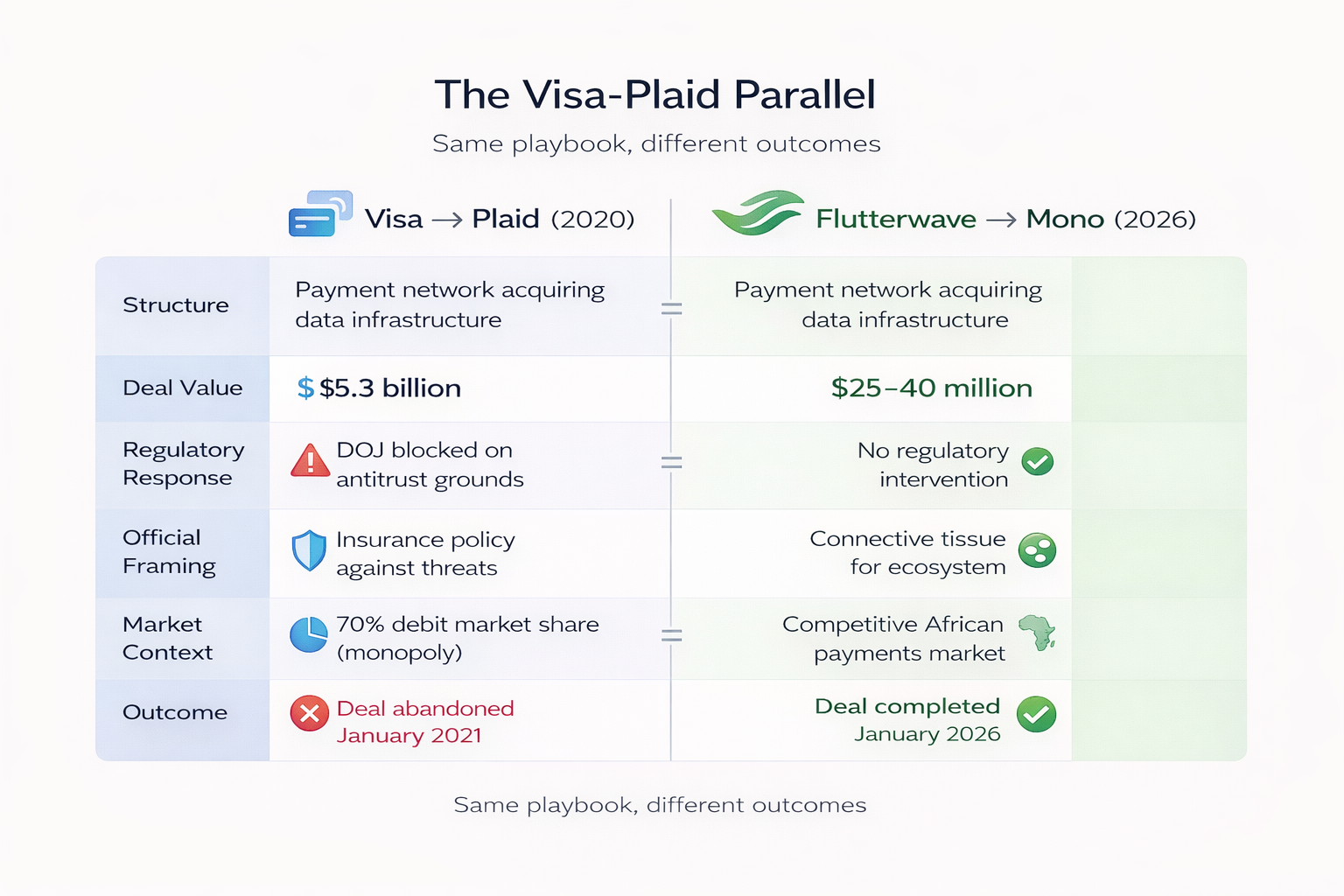
Similar structural questions apply to the Flutterwave-Mono combination. Flutterwave is not merely a passive infrastructure provider. It is an active competitor in payments across Africa. Its competitors include Paystack (owned by Stripe), Interswitch, and numerous other payment processors. Some of these competitors may currently use (or may have used) Mono's infrastructure.
Key governance questions the ecosystem should consider:
Data Firewalls: What structural separations will exist between Mono's data operations and Flutterwave's competitive intelligence? Will there be formal barriers preventing Flutterwave's commercial teams from accessing aggregate insights about competitor transaction patterns?
Access Logs and Auditing: Will there be independent oversight of who accesses what data, and for what purposes?
Board Independence: Mono is stated to remain operationally independent with its leadership intact. But what governance structures will ensure this independence remains meaningful over time?
Operational Separation: The announcement states Mono will "continue to operate independently, with no changes to its leadership structure, team, or day-to-day operations." The durability of these commitments deserves ongoing attention.
To be clear: these are structural ecosystem questions, not accusations. There is no evidence of improper data access or competitive abuse. The responsible framing is to note that when infrastructure and competition combine under single ownership, healthy ecosystems benefit from discussing governance arrangements openly.
Notably, this angle has received minimal coverage in African tech media. Most reporting has focused on the deal's strategic rationale and what it means for the combined entity. The structural implications for the broader ecosystem merit deeper examination.
Integration Risk: Lessons from Global History
#Acquiring open banking infrastructure is one thing; integrating it successfully is another entirely. Global history offers cautionary lessons.
Visa-Tink: Visa's acquisition of European open banking provider Tink closed in 2022. Integration has been slower than anticipated, with technical challenges in harmonizing Tink's infrastructure across different European banking systems.
TrueLayer: The UK open banking provider has expanded aggressively but faced technical struggles when moving across different banking markets, each with unique API implementations and regulatory requirements.
Plaid: Even Plaid, operating primarily in the relatively standardized U.S. market, has dealt with inconsistent bank APIs and the ongoing challenge of maintaining connections across thousands of financial institutions.
African multi-country API infrastructure is arguably even harder. Unlike Europe (with PSD2 standardization) or the U.S. (with its more consolidated banking system), African markets feature wildly different regulatory frameworks, banking technologies, and connectivity infrastructure. Building reliable connections to financial institutions across Nigeria, Kenya, Ghana, and South Africa requires navigating distinct technical and regulatory environments simultaneously.
Flutterwave's track record of operating across 30+ African countries is a significant advantage here. But the company must still overcome the challenge of integrating Mono's data-intensive operations without disrupting the reliability that lenders and fintechs depend on.
A2A Payments: The Most Important Trend of the Next Decade
#Account-to-account (A2A) payments may be the most consequential trend in global payments, and this acquisition positions Flutterwave at the center of it in Africa.
A2A payments allow money to move directly between bank accounts without passing through card networks. Instead of paying Visa or Mastercard interchange fees on every transaction, merchants can accept payments directly from customers' bank accounts at significantly lower cost.
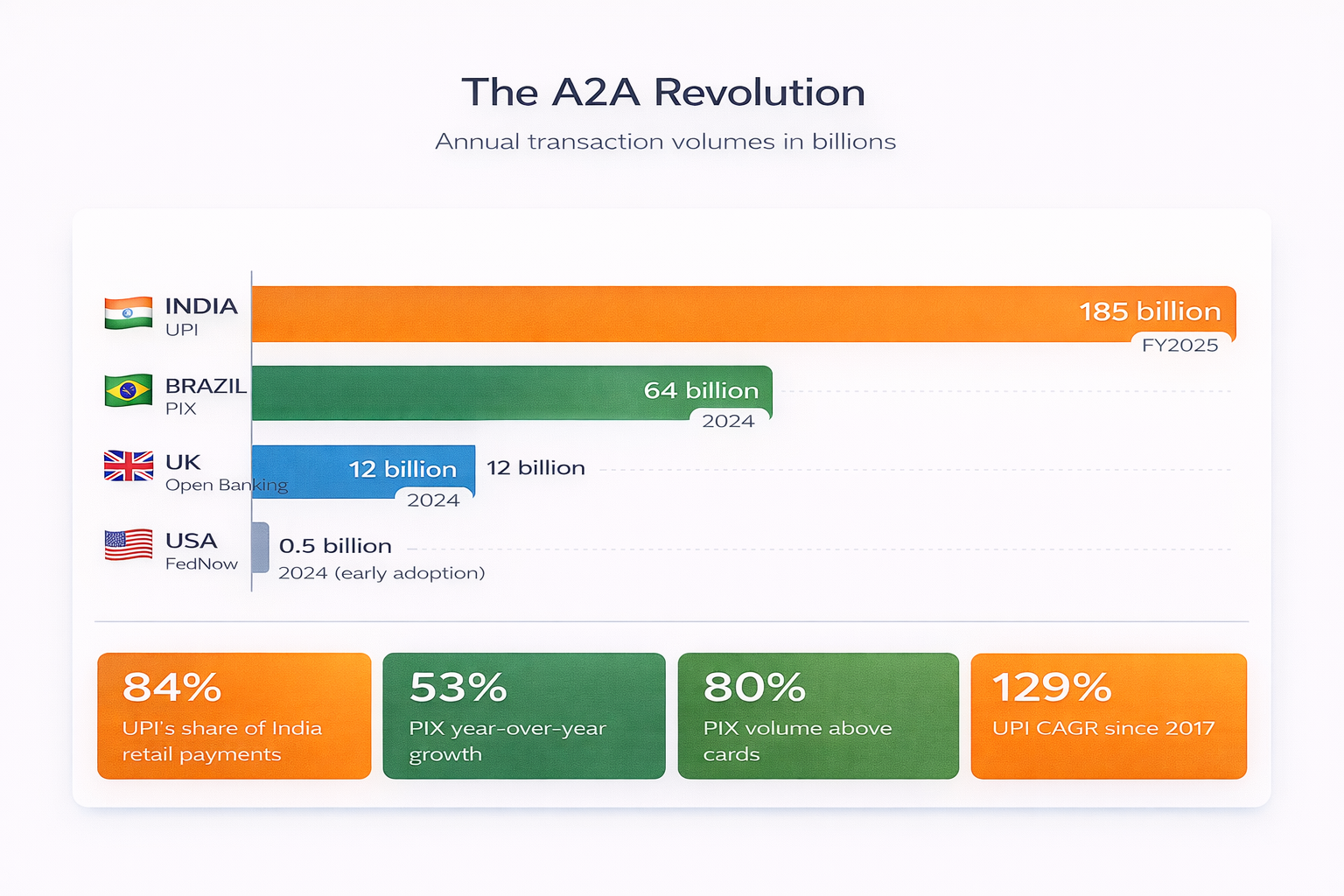
The global evidence is compelling:
India's UPI: The Unified Payments Interface now processes over 185 billion transactions annually, capturing 84% of India's retail payment volume. In FY25, UPI transactions were valued at approximately $3 trillion. The system has grown at a compound annual rate of 129% since 2017.
Brazil's PIX: Launched in November 2020, PIX processed an estimated 64 billion transactions in 2024 (a 53% year-over-year increase), surpassing combined credit and debit card volumes by 80%. PIX now handles over 6 billion monthly transactions and is projected to reach nearly 8 billion monthly by year-end 2025. The system processes approximately $6.7 trillion annually.
UK Open Banking: Open banking-initiated payments continue to grow, though at a more measured pace than India or Brazil.
U.S. FedNow: Launched in 2023, FedNow represents America's entry into instant A2A payments, though adoption remains early.
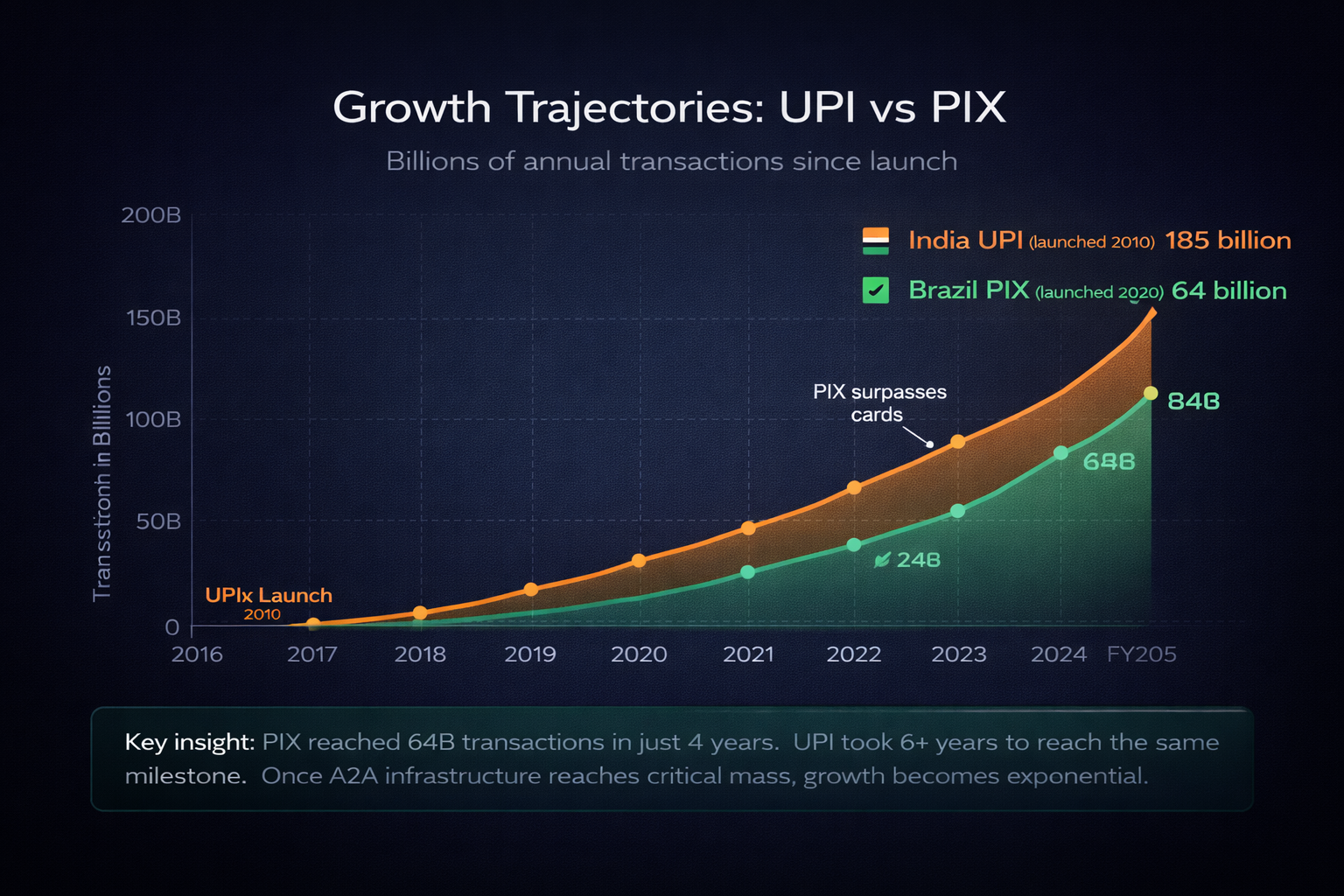
Why merchants prefer A2A: Transaction costs are dramatically lower than card interchange fees. Settlement is instant rather than T+1 or T+2. Fraud patterns differ (though they don't disappear). And the consumer experience, particularly in mobile-first markets, can be seamless.
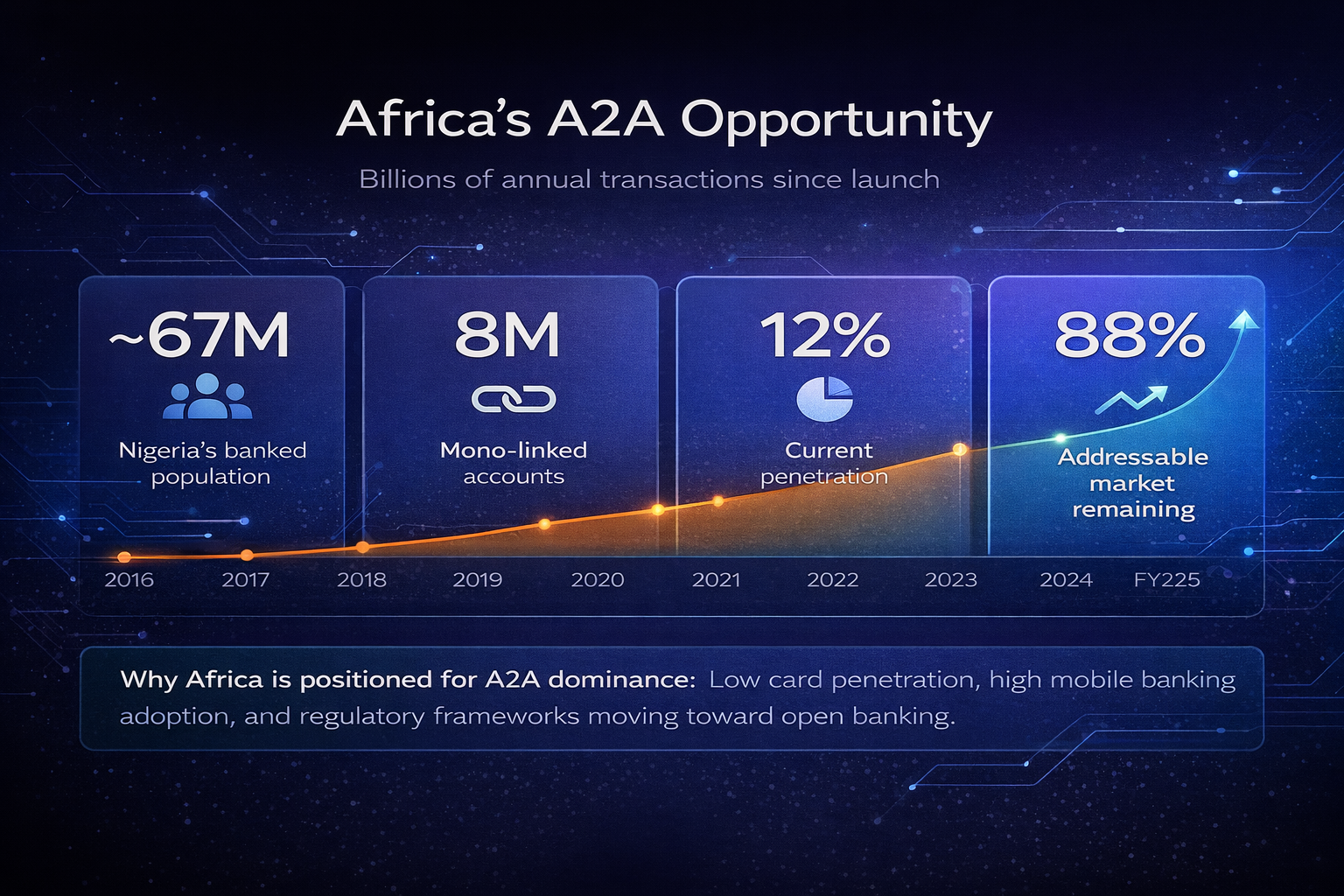
Africa is exceptionally well-positioned for A2A dominance. The continent's card penetration is relatively low. Mobile banking is already ubiquitous. And regulatory frameworks, while still evolving, show movement toward enabling open banking.
Mono's DirectPay product enables exactly this kind of A2A payment. By acquiring Mono, Flutterwave now has the infrastructure to attempt what PIX achieved in Brazil and UPI achieved in India: becoming the default real-time payment rail for an entire economy.
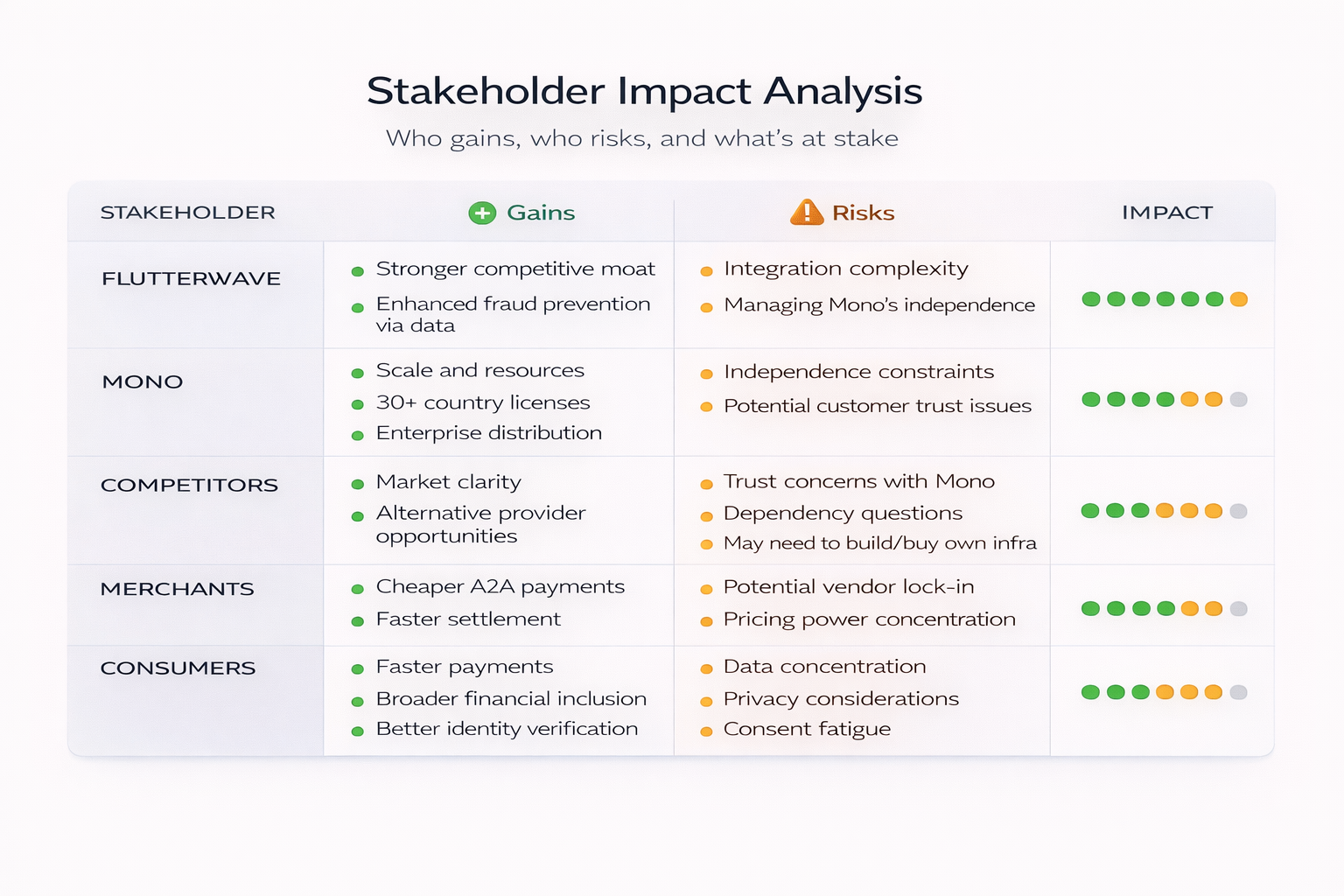
Impact Breakdown: Who Gains and Who Risks Losing
#
A. Flutterwave
#The benefits are clear: a stronger competitive moat, enhanced fraud prevention capabilities through data intelligence, improved underwriting ability (opening potential paths into lending or lending partnerships), and a significantly stronger IPO narrative. Flutterwave moves from being a payments processor to being a financial infrastructure platform.
B. Mono
#Mono gains access to Flutterwave's resources, licenses across 30+ countries, established compliance infrastructure, and enterprise distribution. This solves the scale challenge that open banking providers face when expanding across fragmented markets. The tradeoff is independence. While Mono retains operational autonomy, it is now ultimately owned by a competitor to some of its potential customers.
C. Competitors
#This is where the calculus becomes complex. Companies that compete with Flutterwave in payments but relied on Mono for data infrastructure face a decision: continue using infrastructure now owned by a competitor, or find alternatives. Trust concerns (whether justified or not) may push some players to seek other providers or build in-house capabilities. This could benefit alternative open banking players like South Africa's Stitch or create market opportunities for new entrants.
D. Merchants
#If the acquisition delivers on its promise, merchants could benefit from cheaper A2A payment options, faster settlement, and better fraud prevention through enhanced risk signals. The integration of payments and data should, in theory, reduce friction and cost throughout the payment flow.
E. Consumers
#Potential benefits: Faster payments, broader financial inclusion through alternative credit assessment, and more seamless identity verification.
Potential risks: Increased data aggregation by a single entity, privacy considerations as more financial data flows through connected systems, and the consent fatigue that can accompany proliferating data-sharing requests.
What This Deal Signals About the Future of African Fintech
#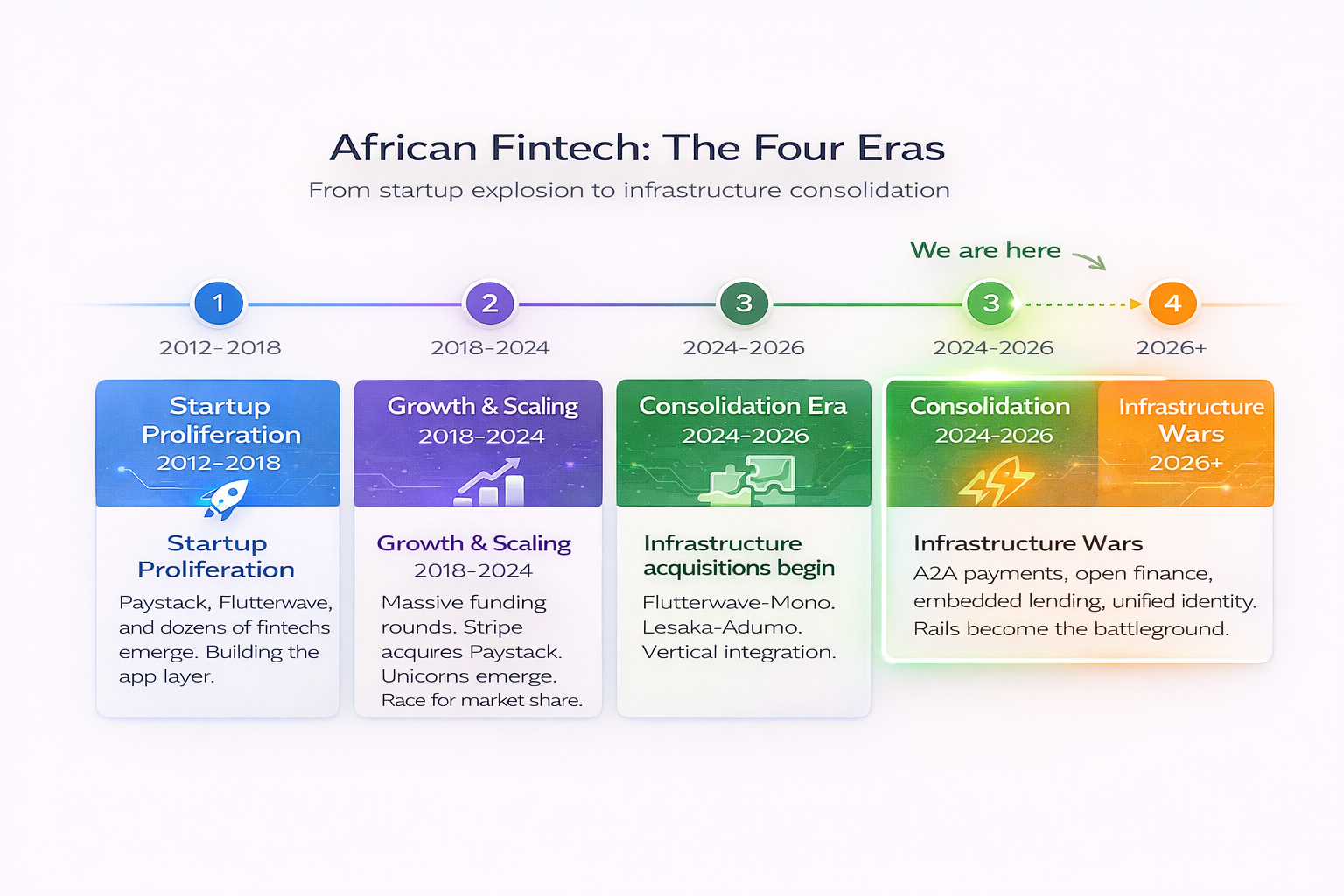
The consolidation era has begun. This acquisition, along with the recent Lesaka-Adumo merger in South Africa, suggests that African fintech is entering a phase where startups that once aspired to become standalone giants may increasingly find better outcomes by integrating into scaled platforms.
Infrastructure is the new battleground. The next decade of African fintech competition will be less about building the best consumer app and more about controlling the underlying rails. Data infrastructure, identity systems, and payment networks will be the terrain on which winners emerge.
Data governance becomes critical. As financial data increasingly concentrates among fewer, larger players, questions of governance, privacy, and ecosystem neutrality will demand attention from regulators, investors, and civil society alike.
The next decade's defining technologies: A2A payments, open finance infrastructure, embedded lending, and unified identity systems. Companies positioned at the intersection of these technologies (as Flutterwave now is) will shape the continent's economic future.
Reader's Takeaway
#
What you should understand: This is not simply a fintech acquisition. It is a structural realignment of African financial infrastructure, combining the continent's largest payment network with its leading open banking provider.
How it reshapes the landscape: Flutterwave has transformed from a payments company into a vertically integrated financial infrastructure platform. Competitors face new strategic calculations. The path to Africa's PIX or UPI moment has become clearer, and more contested.
Why neutrality and governance matter: When infrastructure providers are owned by competitors, trust becomes essential. The governance arrangements, data firewalls, and operational separations matter not just for competitive dynamics but for ecosystem health.
Why this is a turning point: Africa's fintech industry has moved from creation to consolidation. The startups that raised hundreds of millions of dollars over the past decade are now combining, and the resulting entities will be the institutions that define African finance for the next generation.
Questions the ecosystem must now ask:
How do we ensure infrastructure providers serve the entire ecosystem fairly, even when owned by competitors within it? What regulatory frameworks are needed to govern data concentration in financial services? How do we balance the benefits of scale and integration against the risks of reduced competition? And as African financial infrastructure increasingly resembles global patterns, what uniquely African approaches might emerge?
Conclusion
#The Flutterwave-Mono acquisition is, by any measure, strategically brilliant. It positions Flutterwave at the commanding heights of African financial infrastructure, combines payments and data in ways that global giants have pursued at far higher valuations, and creates a platform capable of capturing the A2A payments wave sweeping global finance.
It also raises structural questions that healthy ecosystems should discuss openly. Questions about neutrality, governance, competitive dynamics, and data concentration. Acknowledging these questions does not diminish the deal's strategic merit; it simply recognizes that consequential transactions deserve consequential analysis.
Healthy ecosystems are ones where both strategic accomplishments and structural concerns can be discussed with intellectual rigor and ecosystem maturity. African fintech has grown up enough to deserve this kind of discourse.
African finance's next chapter is being written now, in transactions like this one, in the infrastructure being built, and in the governance arrangements being established. The continent's founders, investors, regulators, and citizens all have stakes in how this chapter unfolds.
The future of African fintech will be built on rails. The question is who controls them, and on what terms.