Table of Contents
#- Introduction
- What Is EigenLayer? (Core Technology Overview)
- The Concept of Restaking: What Does It Mean?
- What Are Actively Validated Services (AVSs)?
- Breaking Down the Architecture of EigenLayer
- What Is the EIGEN Token and What Is It Used For?
- Breaking Down Intersubjective Faults: What Does This Mean?
- Why EigenLayer Matters to Developers
- Why Should the Average Person Care About EigenLayer?
- Future Outlook: Where Could EigenLayer Go From Here?
- Conclusion and Call to Action
Introduction
#"With all the buzz around EigenLayer, I couldn't help but dive deeper into what makes it so interesting. After taking a close look at the tech, here's my take on why it could matter not just to developers but to anyone curious about blockchain innovation."
The blockchain space is constantly evolving, and every now and then, a new protocol comes along that promises to significantly impact how we build decentralized applications. EigenLayer is one of those protocols. As the Web3 ecosystem grows, the demand for scalable and secure decentralized applications (dApps) increases. With the launch of EigenLayer and its native EIGEN token, we now have a way to reuse Ethereum's security to scale the ecosystem without needing to build separate layers of trust from scratch.
So, what exactly does this mean for developers, users, and anyone interested in the blockchain world? Let's break it down.
What Is EigenLayer? (Core Technology Overview)
#"The concept behind EigenLayer is actually pretty simple: it lets people re-use their staked ETH to secure even more decentralized apps. It's like getting extra mileage out of the security you've already put in."
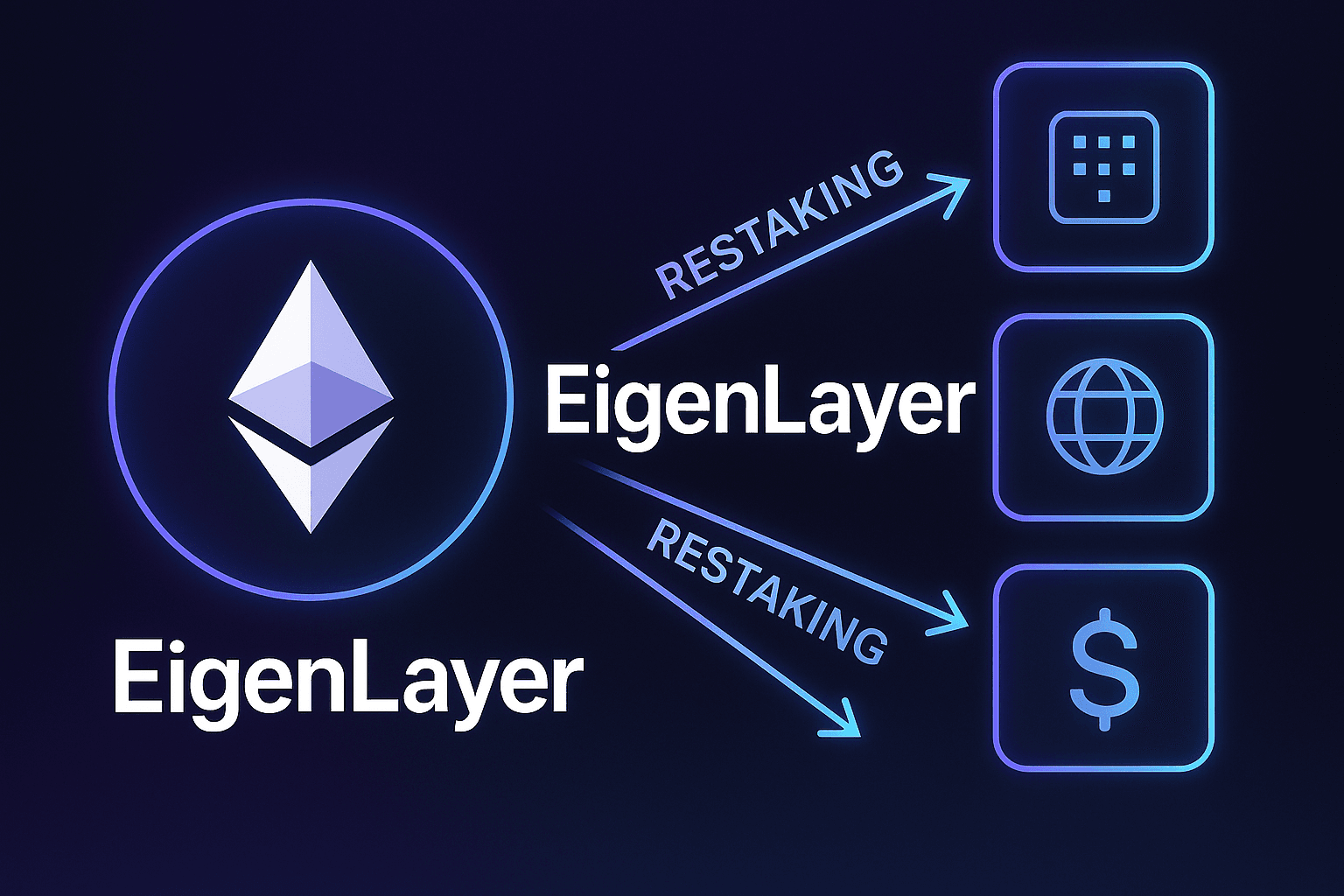
At its core, EigenLayer is a protocol built on Ethereum that allows people who have already staked ETH to re-stake their assets to secure additional decentralized services and applications. This concept of "restaking" is powerful because it leverages Ethereum's security and extends it to other projects, without requiring new capital or resources.
Think of it like reusing the same insurance policy to cover more assets. Imagine you have an insurance policy for your house, and then you find out you can use that same policy to cover your car, your electronics, and even your bike—without buying new policies. You're getting extra value from something you already paid for. EigenLayer allows you to use your already staked ETH in a similar way.
Why does this matter?
#For developers, this means they no longer need to build their own security systems from scratch when launching new applications. Instead, they can tap into Ethereum's well-established security, making their apps more trustworthy and secure. For regular users, this means the applications they use in the Ethereum ecosystem will be safer, with stronger security measures applied across the board.
The Concept of Restaking: What Does It Mean?
#"Restaking is one of those concepts that sounds complex but is actually practical. Imagine if you could lock your ETH once and use it to secure multiple apps at the same time—that's exactly what restaking does."
In blockchain, staking usually means locking up your cryptocurrency to secure a network and validate transactions. Traditionally, your staked assets are tied to a single purpose—to secure one specific blockchain or protocol. But EigenLayer changes this by enabling restaking, where you can use those same assets to secure multiple services.
Think of it like using the same security deposit for multiple apartments. You paid a security deposit for one apartment, but now, the landlord allows you to use that same deposit for three additional apartments, giving you more protection for your money. Restaking allows you to secure multiple applications with the same staked ETH, making it more efficient for users and developers alike.
Why is this significant?
#It allows Ethereum stakers to earn rewards while securing multiple applications, and it makes the security model more scalable. Developers can launch applications that rely on the existing Ethereum security layer, allowing for faster and more cost-effective development of decentralized applications.
What Are Actively Validated Services (AVSs)?
#"AVSs are where this really gets interesting. These services can tap into Ethereum's security pool without having to build their own security from scratch, which makes it way easier to launch secure apps. Think about how that could speed up innovation in DeFi, oracles, and more."
Actively Validated Services (AVSs) are decentralized applications and services that rely on external validators to secure and validate their operations. These services can be anything from DeFi (Decentralized Finance) applications to oracles (services that provide real-world data to smart contracts).
It's like hiring a third-party inspector when buying a house. Rather than just trusting the seller, you bring in an inspector who validates that the house is in good condition. Similarly, AVSs rely on validators to ensure that they're secure and operational, using the staked assets from Ethereum.
Why is this useful?
#AVSs no longer need to create their own complex security systems. Instead, they can use EigenLayer to tap into Ethereum's existing security. This reduces the costs and speeds up the time to launch new decentralized applications. Imagine how much faster we could see innovation in DeFi, oracles, and other decentralized applications with this model.
Breaking Down the Architecture of EigenLayer
#"Let's take a moment to get under the hood of EigenLayer and see how it all works. If you're a developer or someone curious about blockchain infrastructure, this part is where the magic happens. Understanding the architecture is key to seeing how restaking, validation, and security all come together."
Restaking Mechanics
#At the heart of EigenLayer's architecture is the concept of restaking, which allows users to extend the security of their staked ETH to multiple decentralized applications. This is achieved through a set of smart contracts that manage the staking and delegation process.
In simple terms:
- Stakers (Ethereum holders who have already locked their ETH) can choose to "opt-in" to EigenLayer by interacting with its smart contracts. This opt-in process allows them to delegate their staked ETH to Actively Validated Services (AVSs).
- Each time a user opts to restake, they're essentially providing collateral that helps secure additional decentralized applications (AVSs) without removing their ETH from the Ethereum staking pool.
Think of it like lending your existing security deposit to multiple rental properties. You only put down the deposit once, but it's being used as collateral for multiple properties, ensuring the landlord has protection across various buildings.
Validator and Operator Roles
#One key aspect of EigenLayer's architecture is the interaction between validators, operators, and stakers:
- Validators play a critical role in ensuring that the AVSs (decentralized applications) are functioning correctly. Validators are responsible for running AVS software, ensuring that everything is operating securely.
- Operators are the entities that run the technical infrastructure (e.g., servers, nodes) for the AVSs. They make sure the applications are up and running while maintaining the security requirements of EigenLayer.
- Stakers (those who restake their ETH) delegate their assets to operators and validators. In return, they earn rewards when the services function correctly.
This interaction creates a mutual relationship:
- Stakers earn additional rewards for helping secure AVSs.
- Operators are incentivized to keep their services running smoothly.
- Validators ensure that any misbehavior by operators results in penalties or slashing (where a portion of staked tokens is taken away).
Imagine a construction project where stakers are like investors, operators are like contractors, and validators are the inspectors. Investors provide the funds (collateral), contractors build the project, and inspectors ensure everything is up to code. If a contractor fails to meet the standards, they face penalties, just like an operator who underperforms in EigenLayer.
Cryptoeconomic Incentives and Slashing
#The entire EigenLayer architecture is built on cryptoeconomic incentives, ensuring that all participants are motivated to act in the network's best interests. These incentives are what keep validators and operators honest:
- Rewards: Validators and operators earn rewards for performing tasks correctly and securing AVSs. These rewards come from fees generated by the AVSs and are distributed proportionally to the stakers, validators, and operators.
- Slashing: If a validator or operator behaves maliciously or fails to meet security requirements, they face slashing, meaning that a portion of their staked ETH or EIGEN tokens is forfeited. This acts as a deterrent against misbehavior and keeps the network secure.
The slashing mechanism is critical because it ensures that the network remains trustworthy. Validators and operators have skin in the game—if they fail to uphold security, they lose a portion of their collateral, encouraging them to act in good faith.
Think of slashing like a performance bond in construction. Contractors (operators) put down a bond to guarantee they will finish the project. If they fail to deliver, the bond is forfeited as a penalty. Similarly, in EigenLayer, validators and operators face slashing if they don't perform their duties as expected.
Interaction with Ethereum's Base Layer
#One of the most important aspects of EigenLayer is how it interacts with Ethereum's base layer. EigenLayer doesn't create a completely separate security system—it builds on top of Ethereum's existing security. This is what makes restaking possible and efficient.
Here's how the interaction works:
- Staked ETH: When users stake ETH in the Ethereum network, they're helping secure Ethereum's core functionality (validating transactions and maintaining consensus).
- Restaking in EigenLayer: Through EigenLayer's smart contracts, stakers can opt to use their staked ETH to secure other services (AVSs), while still maintaining their original stake in Ethereum's network.
- No Double-Spending: EigenLayer's architecture ensures that stakers are not at risk of double-spending their security. The system manages both Ethereum's core security and the security of AVSs through smart contracts that carefully track where assets are being deployed.
Think of it like a shared security system in a neighborhood. Each house (like an AVS) in the neighborhood can opt into using the same security company that protects the entire neighborhood (Ethereum). Each house still benefits from the neighborhood-wide security, but they also get additional protection from the shared service.
What Is the EIGEN Token and What Is It Used For?
#"Now, the EIGEN token isn't just some speculative asset—it's key to how the whole system works. It's used for staking, validation, and even governance. In my view, tokens with real utility like this are what drive adoption."
The EIGEN token is central to the functioning of the EigenLayer ecosystem. While some tokens exist purely for speculation, EIGEN serves a functional role by powering staking, validation, and governance across the network.
How the EIGEN Token Is Used
#- Staking: Users lock up their EIGEN tokens to secure decentralized apps (AVSs) and earn rewards.
- Validation: Validators use EIGEN tokens to verify and secure tasks on the network. Validators face penalties if they act maliciously or perform poorly.
- Governance: EIGEN token holders can vote on important protocol changes, giving them a say in how EigenLayer evolves over time.
Think of EIGEN tokens like membership points in a loyalty program. You use them to participate in the network, earn rewards, and even vote on changes to the program. They're not just for trading, they have real utility within the system to ensure everything runs smoothly.
Why does this matter?
#The EIGEN token drives the entire system by incentivizing users to stake their assets and secure the network. It also ensures that only trusted validators are securing the services, since bad actors face penalties. This aligns the incentives of everyone involved in the ecosystem.
Breaking Down Intersubjective Faults: What Does This Mean?
#"This might sound like a fancy term, but 'intersubjective faults' are just problems that people or systems agree happened, even if they can't be proven on-chain. A real-world example? Think of verifying whether data is available across the network—something that might not always be verifiable through code alone."
Intersubjective faults are errors or failures in tasks that can't be proven purely with data on the blockchain, but can be agreed upon by external validators or observers. These are often subjective issues that require consensus to resolve.
Imagine you're working on a group project. While everyone has their own tasks, there are some things that only the group as a whole can decide, like whether the final presentation is good enough. That's an intersubjective decision—it requires the agreement of everyone involved, rather than something you can prove with data alone.
Why does this matter?
#In blockchain, not everything can be objectively verified. Some things—like whether data is available or whether a service is functioning properly—require agreement from external parties. EigenLayer uses the EIGEN token to secure services that deal with these kinds of faults, ensuring penalties are applied when things go wrong.
Why EigenLayer Matters to Developers
#"As someone who's seen how tricky it can be to launch decentralized apps securely, EigenLayer solves a big pain point for developers. It allows you to tap into Ethereum's security, which makes it cheaper and faster to build reliable apps. This could be huge for scaling the Web3 ecosystem."
For developers, security is one of the biggest challenges when building decentralized applications. It's time-consuming and expensive to create a trust network that ensures the app is safe. EigenLayer solves this problem by letting developers reuse Ethereum's security through restaking, providing a ready-made solution that saves both time and resources.
Imagine you're building a new business and you need security systems to keep everything safe. Instead of purchasing and installing your own expensive security infrastructure, you rent access to a well-established security company. This allows you to protect your business at a lower cost and focus on what really matters—building and growing the business.
Why this is important
#By using EigenLayer, developers can rely on a trusted and robust security framework while focusing on their core application development. This opens the door for more innovation because developers can allocate fewer resources to security, resulting in a more scalable ecosystem for Web3 applications.
Why Should the Average Person Care About EigenLayer?
#"If you're not a developer, you might wonder why this matters to you. Here's why: the more secure and reliable apps are, the more we all benefit as users. Plus, for people staking ETH, restaking lets you earn more without any extra effort. It's a win-win."
If you're not a developer, you might wonder why this matters to you. But as users, we all benefit from secure and reliable applications. When developers can focus more on building functional apps rather than worrying about security, the services and apps we use become more stable and trustworthy.
Imagine you're using an online service like a banking app. If that app doesn't have the best security infrastructure, your data and money could be at risk. But if the service uses a well-established, shared security infrastructure, you can rest easy knowing that multiple layers of protection are in place. EigenLayer functions in a similar way, pooling security resources so that decentralized apps are more secure, benefiting users.
Why it matters
#As an average user, EigenLayer means that the decentralized applications you use will have stronger security, making your interactions safer. Plus, if you're someone who has staked ETH, restaking allows you to earn more rewards without any extra effort.
Future Outlook: Where Could EigenLayer Go From Here?
#"Looking ahead, I think EigenLayer could become a core part of Ethereum's infrastructure. The ability to reuse security across multiple apps could lead to a more scalable and secure Web3 ecosystem. But of course, as with any early-stage technology, there are always risks."
As blockchain technology continues to grow, EigenLayer has the potential to become a crucial part of Ethereum's infrastructure. By providing a scalable pooled security model, EigenLayer could help developers build decentralized applications more quickly, securely, and efficiently, potentially transforming how dApps are developed.
However, as with any early-stage technology, there are risks. The project will need to prove its ability to scale, gain widespread adoption, and maintain the trust of the Ethereum community.
Conclusion and Call to Action
#"So that's my take on EigenLayer. Whether you're a developer looking to build secure apps or just someone curious about how decentralized systems work, this tech could be a key player in the future of Ethereum. Let's see where it goes."
EigenLayer introduces an innovative way to reuse Ethereum's security for multiple decentralized applications, making it a promising development in the Web3 space. Whether you're a developer looking to build more secure apps or just curious about how decentralized systems work, EigenLayer could play a pivotal role in the future of Ethereum and decentralized applications.
If you're interested in diving deeper into the technology, I recommend checking out EigenLayer's official documentation to explore more about its architecture, how staking works, and what future developments may look like. You can find it here: EigenLayer Docs.
What are your thoughts on EigenLayer? Do you see it as a game-changer for Web3 development, or do you have concerns about the restaking model? Let me know in the comments below!