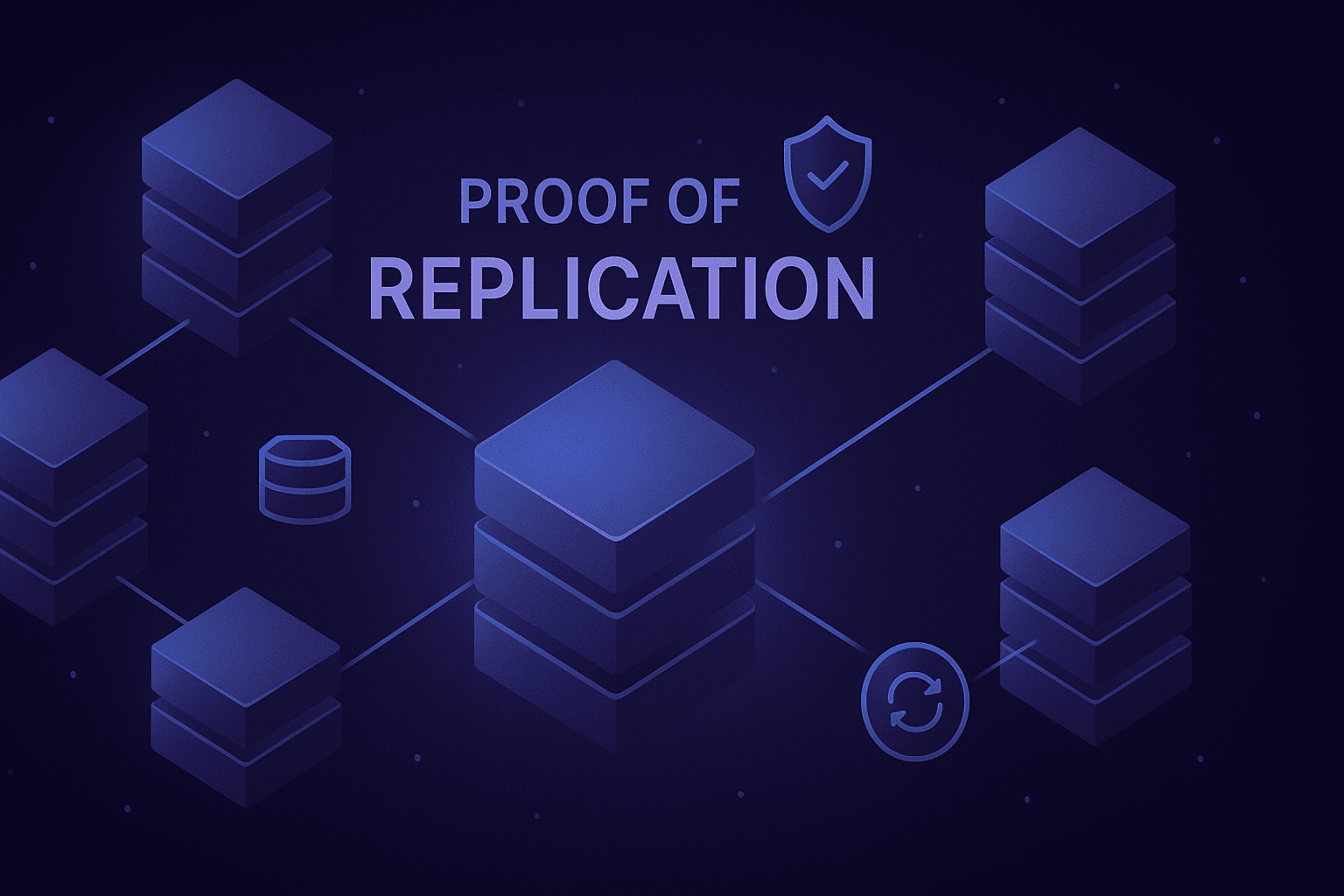
Explaining Proof of Replication Like You're 5 Years Old
#The Big Problem: Where Do We Store All This Data?
#Imagine your school library has a huge book collection, but:
- Only one librarian (Bitcoin, Ethereum) keeps all the books
- Everyone has to go to that one librarian for information
- If the librarian is busy, you have to wait!
This is how most blockchains work—they rely on a small number of people storing all the data.
Problem: As blockchains grow, storing all the transactions gets harder and more expensive!
The Magic Solution: Proof of Replication (PoRep)
#Now, imagine that instead of one librarian, there are hundreds of student helpers around the school.
- Each helper has a copy of the books (Solana's blockchain data)
- Whenever someone needs a book, they can go to the nearest helper instead of waiting in line
- Everyone proves they actually have the books by showing random pages on demand!
This is what Proof of Replication (PoRep) does for Solana!
How Proof of Replication Works
#- Step 1: Store the Data – Validators store copies of the blockchain history
- Step 2: Prove You Have It – The network randomly asks for proof that they still have the data
- Step 3: Fast Verification – If a validator can't provide proof, they are removed
Why Proof of Replication is Important
#- No single point of failure – If one validator goes offline, others have copies
- Faster access to data – More copies = faster transactions
- Prevents cheating – Validators must prove they actually store data to earn rewards
Summary: Proof of Replication in Simple Terms
#- Old blockchains rely on a small number of people storing data (slow & expensive)
- Solana spreads copies everywhere using PoRep (fast & efficient)
- Validators prove they have data by showing random pieces when asked
- This makes Solana more reliable, decentralized, and scalable!
Context & Problem Statement (Technical Deep Dive)
#(Reference: Solana Whitepaper, Section 6, Pages 21-25)
As blockchain networks grow, the challenge of data storage becomes increasingly critical. Traditional blockchains require full nodes to store complete copies of the ledger, creating significant barriers to participation and scalability. The storage problem isn't just about capacity—it's about ensuring data availability, preventing corruption, and maintaining decentralization.
Bitcoin and Ethereum face this challenge by requiring full nodes to store hundreds of gigabytes of data, making it expensive and impractical for many participants to run complete nodes. This creates centralization pressures and limits the network's ability to scale.
Solana's whitepaper presents a revolutionary solution: what if we could create a system that ensures data availability without requiring every node to store everything? What if we could verify that data is stored correctly without expensive verification processes?
What is Proof of Replication (PoRep)?
#In a decentralized blockchain, nodes must store a full copy of the ledger to validate transactions. As blockchains grow, storage becomes a major challenge. Proof of Replication (PoRep) is Solana's method for ensuring that data is stored securely and efficiently by network participants.
"Replication is not used as a consensus algorithm, but is a useful tool to account for the cost of storing the blockchain history or state at a high availability."
– (Solana Whitepaper, Page 21)
Why is PoRep Needed?
#- Ensures data availability – Prevents loss of historical blockchain data
- Prevents dishonest storage – Verifies that nodes actually store the data they claim to have
- Optimizes storage efficiency – Uses encryption to make storage verifiable and tamper-proof
How Does Proof of Replication Work?
#Step 1: Data Encryption Using Cipher Block Chaining (CBC)
#- Nodes encrypt blockchain data block by block using a CBC encryption method
- The output of each block depends on the previous one, ensuring data integrity
- This prevents manipulation or selective storage of only certain parts of the blockchain
"CBC encryption encrypts each block of data in sequence, using the previously encrypted block to XOR the input data."
– (Solana Whitepaper, Page 21)
How CBC Encryption Works:
- Each data block is encrypted using the previous block's output
- This creates a chain where changing any block invalidates all subsequent blocks
- Prevents partial storage attacks and ensures data integrity
Step 2: Generating a Proof
#- The replicator (storage node) signs a randomly selected hash from the PoH sequence
- A pseudorandom number generator (PRNG) picks random 32-byte slices from each encrypted block
- These slices are hashed together into a Merkle root – a unique proof that the node is actually storing the data
"A merkle hash is computed with the selected PoH hash prepended to each slice."
– (Solana Whitepaper, Page 22)
Proof Generation Process:
- Random Selection: PoH hash determines which data slices to examine
- Slice Extraction: PRNG selects random 32-byte chunks from encrypted blocks
- Merkle Tree: Slices are hashed together to create a verifiable proof
- Signature: The proof is signed with the replicator's private key
Step 3: Verification by the Network
#- Other nodes verify that the proof is valid by:
- Checking if the selected PoH hash is correct
- Ensuring that the random slices match the encrypted data
- This process is efficient and scalable because it only verifies small chunks of data rather than the entire blockchain
"With N cores, each core can stream encryption for each identity."
– (Solana Whitepaper, Page 23)
Verification Process:
- Hash Validation: Verify the PoH hash is legitimate
- Slice Verification: Check that random slices match encrypted data
- Merkle Proof: Validate the Merkle tree construction
- Signature Check: Confirm the proof is signed by the replicator
Why PoRep is Efficient and Secure
#1. Fast Verification Using GPUs
#- Since verification only requires checking small data slices, it can be parallelized across thousands of GPU cores
- Modern GPUs have 3500+ cores, allowing thousands of proofs to be verified simultaneously
GPU Parallelization Benefits:
- Massive Parallelism: Thousands of cores can verify different proofs simultaneously
- Cost Efficiency: GPUs are more cost-effective than CPU clusters for this workload
- Scalability: More GPUs mean faster verification as the network grows
2. Prevents Partial Storage (Erasure Attacks)
#- Nodes cannot store only parts of the blockchain while pretending to have the full ledger
- The randomized data selection process ensures that nodes must store the entire dataset
"If a user storing 1 terabyte of data erases a single byte from each 1-megabyte block, the likelihood of detection after 5 proofs is 99%."
– (Solana Whitepaper, Page 24)
Erasure Attack Prevention:
- Random Sampling: PoH hash determines which data to verify
- High Detection Rate: 99% chance of catching partial storage after 5 proofs
- Economic Disincentive: Slashing penalties make partial storage unprofitable
3. Key Rotation for Extra Security
#- PoRep keys change periodically, forcing nodes to re-encrypt data regularly
- This prevents cheap re-use of old proofs and ensures continuous participation
"Rotation needs to be slow enough that it's practical to verify replication proofs on GPU hardware."
– (Solana Whitepaper, Page 23)
Key Rotation Benefits:
- Prevents Proof Reuse: Old proofs become invalid when keys rotate
- Continuous Verification: Forces ongoing participation and data storage
- Security Enhancement: Regular re-encryption prevents long-term attacks
How PoRep Prevents Fraud and Attacks
#1. Spam Protection
#- Malicious users cannot flood the network with fake proofs because verification requires actual stored data
"To facilitate faster verification, nodes must provide the encrypted data and the entire Merkle tree when requesting verification."
– (Solana Whitepaper, Page 24)
Spam Prevention Mechanisms:
- Proof Requirements: Must provide actual encrypted data, not just signatures
- Merkle Tree Validation: Full tree structure must be provided for verification
- Economic Costs: Generating fake proofs requires significant computational resources
2. Collusion with PoH Generator
#- Even if a replicator colludes with the PoH generator to create a biased hash
- The signed hash is unique per replicator
- Any attempt to precompute a fake proof is easily detectable
Collusion Prevention:
- Unique Signatures: Each replicator has a unique signing key
- PoH Independence: PoH sequence is independent of individual replicators
- Verification Requirements: Multiple parties must verify each proof
3. Denial of Service (DoS) Protection
#- A node must prove storage before being recognized as a replicator
- The network dynamically adjusts the number of replicators, preventing attacks
DoS Protection Mechanisms:
- Proof Requirements: Must demonstrate actual data storage before participation
- Dynamic Scaling: Network adjusts replicator count based on demand
- Economic Barriers: Storage costs make DoS attacks expensive
4. Economic Incentives
#- Storage providers earn SOL rewards for successfully providing replication proofs
- This ensures that data remains available, even if certain nodes go offline
"The PoS verifiers can submit false proofs a small percentage of the time. They can prove the proof is false by providing the function that generated the false data."
– (Solana Whitepaper, Page 25)
Economic Incentive Structure:
- Reward System: SOL tokens for successful proof generation
- Penalty System: Slashing for false or missing proofs
- Market Dynamics: Supply and demand determine storage costs
How PoRep Differs from Filecoin's Proof of Storage
#Solana's PoRep is inspired by Filecoin's Proof of Replication but optimized for high-speed blockchain validation.
| Feature | Solana (PoRep) | Filecoin (PoRep) |
|---|---|---|
| Main Purpose | Verifying blockchain data storage | Storing user-uploaded files |
| Encryption Method | CBC encryption with PoH | Unique data encoding |
| Verification Speed | GPU-accelerated, very fast | Slower due to deep encryption |
| Economic Model | Validators earn SOL for storing data | Miners earn FIL for storage deals |
"Filecoin proposed a version of Proof of Replication. This version is designed for fast and streaming verifications."
– (Solana Whitepaper, Page 21)
Key Differences:
- Optimization Focus: Solana prioritizes speed, Filecoin prioritizes security
- Data Type: Solana stores blockchain data, Filecoin stores arbitrary files
- Verification Method: Solana uses PoH for randomness, Filecoin uses unique encoding
- Performance: Solana's approach enables faster verification and higher throughput
Real-World Benefits of PoRep
#Fast Verification
#- Allows blockchain nodes to verify only small data slices, reducing computational load
- GPU parallelization enables thousands of proofs to be verified simultaneously
- Minimal latency for data availability checks
Prevents Data Loss
#- Ensures that entire blockchain history is stored without corruption
- Multiple replicas provide redundancy and fault tolerance
- Erasure attack prevention ensures complete data integrity
Reduces Costs
#- By optimizing storage and using parallel GPU verification, Solana minimizes hardware costs for nodes
- Efficient verification reduces the computational overhead of data storage
- Economic incentives ensure cost-effective storage provision
Scalability
#- Enables Solana to handle exponentially growing data without performance issues
- Distributed storage prevents centralization of data access
- Dynamic scaling adjusts storage capacity based on network needs
Conclusion & What's Next
#Key Takeaways
#- Proof of Replication (PoRep) ensures secure and efficient blockchain storage
- Encryption and randomized verification prevent fraudulent storage claims
- PoRep uses GPUs for fast verification, ensuring minimal performance overhead
- This makes Solana scalable, allowing it to process massive amounts of historical data
What's Next
#In the next section, we'll explore Solana's System Architecture & Performance—how Solana achieves its record-breaking 65,000+ transactions per second (TPS).
The Proof of Replication mechanism we've explored today provides the storage foundation that enables Solana's high-performance blockchain. By ensuring data availability without requiring every node to store everything, PoRep allows Solana to scale while maintaining decentralization and security.
This article is part of the Solana Whitepaper Series. Read Part 1: Introduction & Core Idea | Read Part 2: Network Design | Read Part 3: Proof of History | Read Part 4: Proof of Stake | Read Part 6: System Architecture & Performance (Coming Soon)